

Fifty-three. That’s not a typo, and it’s not a rounding error. As of the 2025 college football season, 53 German-born players are competing at the NCAA Division I level — the highest total in the history of the sport in Germany. To put that in perspective: a decade ago, the number was in the single digits. What’s happening right now isn’t coincidence — it’s the result of a systematic build-up of infrastructure, international recruiting networks, and a generation of German athletes who believed college football was a realistic path. They were right.
Position Breakdown: OL Leads, DL Follows, Germany Does the Dirty Work
If you’re looking for Germans on the field, start in the trenches — and stay there. The 53 players break down as follows: OL leads with 18, making it by far the most represented position group. DL follows with 12, and when you add DE (4) and DT (2), the defensive front accounts for 18 players on its own — a trench-to-trench symmetry that says something about the type of athlete Germany is producing. TE comes in third with 7, a position group with disproportionate NFL draft visibility. Rounding out the list: WR (3), P (2), LB (2), RB (1), LS (1), and K/P (1). Germany is predominantly an interior lineman factory — and that’s not a criticism. It’s a reflection of the developmental pipeline.
Conference Map: The SEC Is the German Stronghold
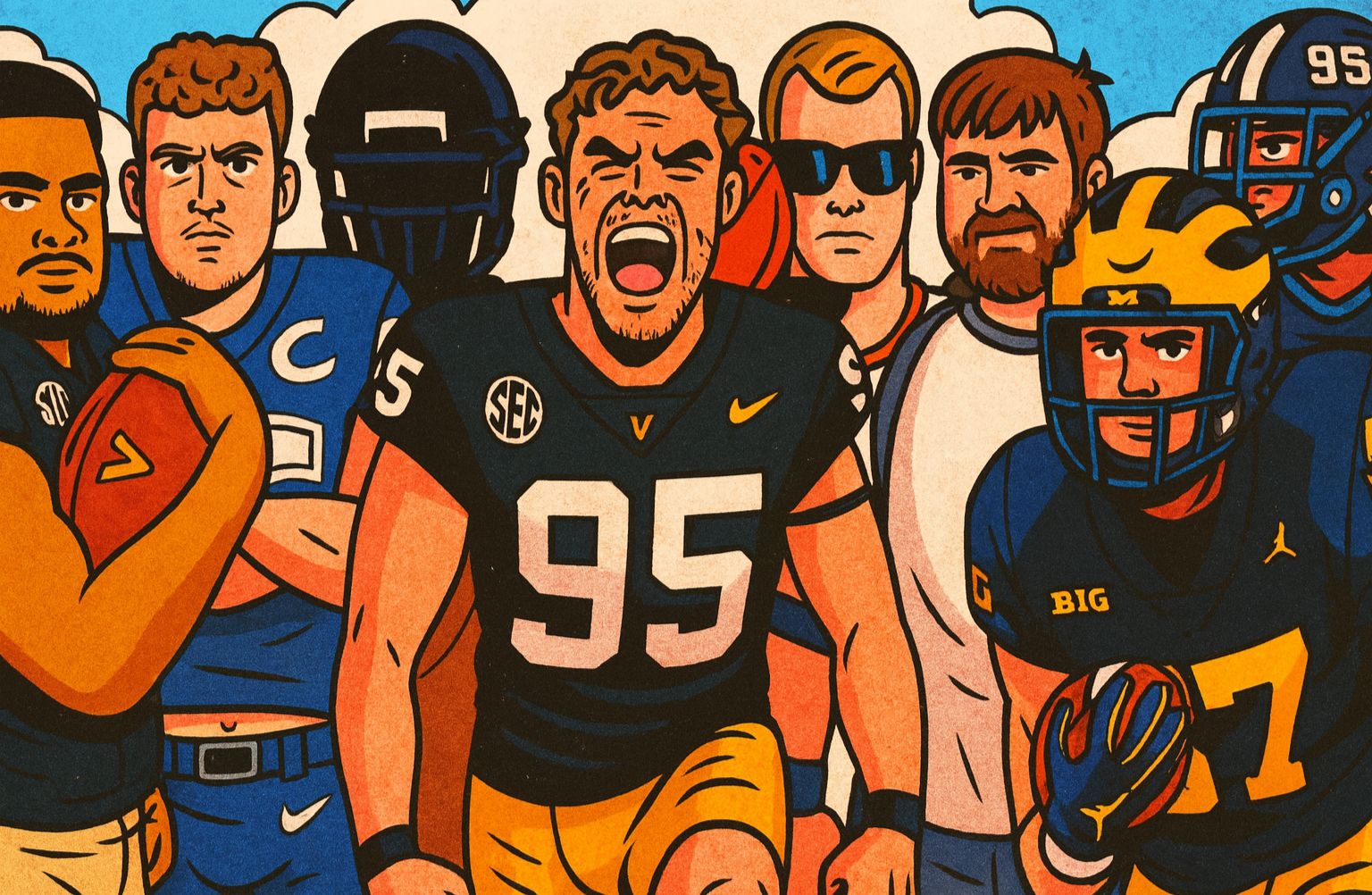
Forget the assumption that Germans are clustered in mid-major conferences. The data says otherwise. In the FBS, the SEC leads with 7 German players — the most of any conference. Sun Belt and AAC each have 5, followed by Big Ten, MAC, and ACC with 3 each. Mountain West has 2, CUSA and the Big 12 have 1 each. That SEC number is significant: Germans at Georgia (Jayden-Jamal Hanne), Texas (Hero Kanu), Florida (Noel Portnjagin), South Carolina (Justin Okoronkwo), and Vanderbilt (Yilanan Ouattara, Linus Zunk, Terry Nwabuisi-Ezeala). Three Germans at Vanderbilt alone. In the FCS, Big Sky and SoCon lead with 4 each, followed by NEC, Ivy League, and CAA with 3 each.
FBS vs. FCS: 30 to 23, and Both Sides Are Real
Of the 53 Germans, 30 play FBS (57%) and 23 play FCS (43%). FCS is not a consolation prize. Programs like Dartmouth, Idaho, and Northern Colorado are developing players who arrived with limited football backgrounds and turning them into legitimate prospects. Several Germans currently on FBS rosters took the FCS-to-transfer path. The Ivy League, which offers zero athletic scholarships, is home to three Germans who chose academic-athletic balance deliberately — including two at Dartmouth alone. The FBS/FCS split tells us Germany is producing athletes across multiple readiness tiers. That’s what a functioning pipeline looks like.
Notable Prospects: The Germans Worth Watching in 2025
Marlin Klein — TE, University of Michigan (Big Ten). Klein is the headline. A tight end at Michigan operating in the Big Ten, he functions as a legitimate receiving threat and credible blocker — the combination NFL teams actually want at the position. Current projection: Round 3 of the 2026 NFL Draft. He’s not “good for a German.” He’s good.
Alexander Honig — TE, University of Connecticut (AAC). Honig enters his redshirt senior season at UConn as one of the most experienced German TEs in the country. As a potential 2026 draft candidate, his final year could define whether he enters the league conversation.
Hero Kanu — DT, University of Texas (SEC). A senior defensive tackle at Texas. A DT with SEC experience and senior status is NFL-adjacent by definition. His 2025 production will determine how seriously scouts engage.
Jayden-Jamal Hanne — DL, University of Georgia (SEC). A freshman at Georgia. UGA runs one of the most selective recruiting processes in the country. Hanne’s presence on that roster as a German freshman is genuinely historic.
Paul Rubelt — OL, UCF (Big 12). Rubelt’s UCF Pro Day results drew conversations with reportedly 20 of 32 NFL teams. As a senior offensive lineman with Big 12 experience, he represents the archetype the German pipeline has been trying to build: IPP to D1 to legitimate NFL prospect.
Germany Is an Export Nation — and the Numbers Back It Up
53 players. 30-plus programs. SEC, Big Ten, ACC, Big 12 representation. At least five legitimate NFL draft prospects in the 2026 class. Germany’s American football infrastructure has crossed a threshold that most international football markets haven’t reached: it’s not just producing players who can survive in the American system — it’s producing players who start, contribute, and get drafted in the rounds that matter. The pipeline is real because the numbers are real. And the next wave is already in it.